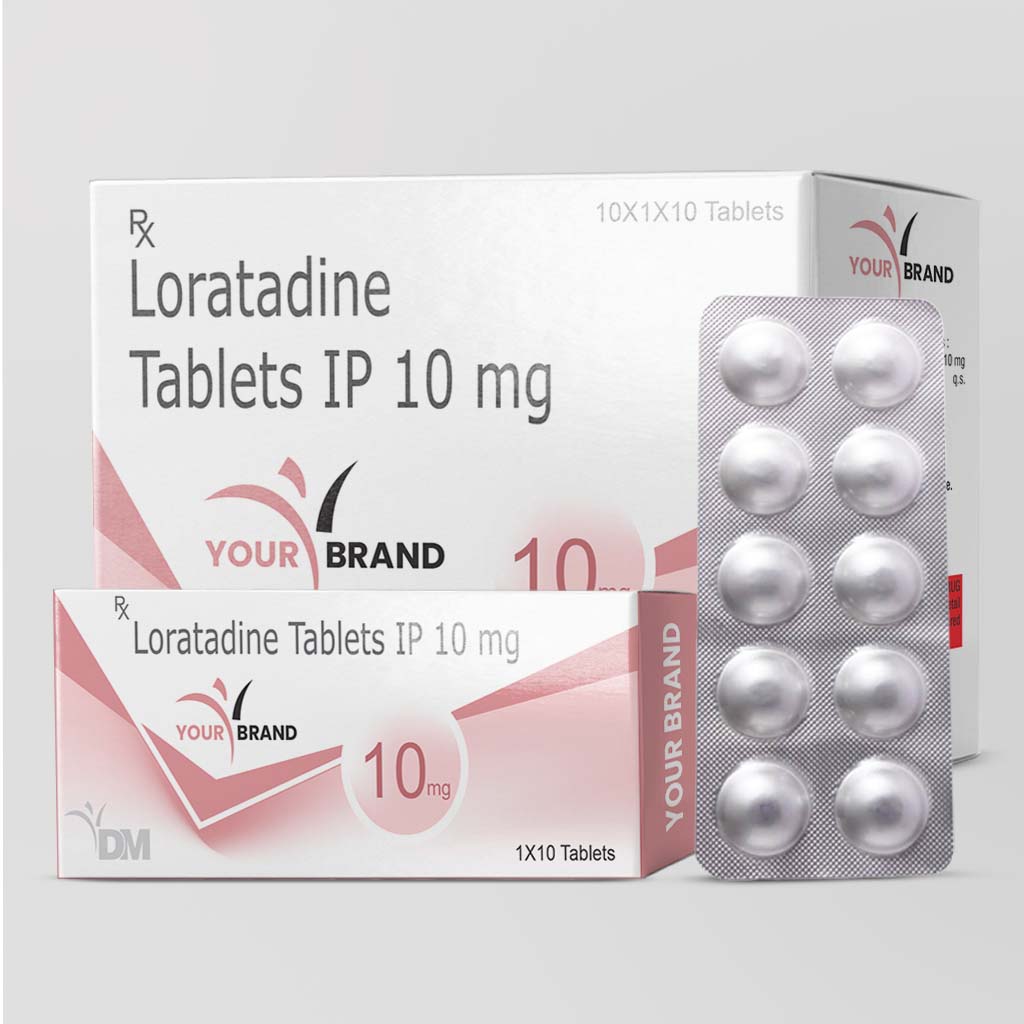
Loratadine Tablets

Project Image

Therapeutic Indication

Allergic rhinitis (seasonal and perennial)
Chronic urticaria (hives)
Skin allergies
Sneezing and runny nose
+91 85919 78885

Loratadine

Tablet

Loratadine ,is an antihistamine that reduces the effects of natural chemical histamine in the body. Histamine can produce symptoms of sneezing, itching, watery eyes, and runny nose. It is used to treat sneezing, runny nose, watery eyes, hives, skin rash, itching, and other cold or allergy symptoms. It is also available in combination with pseudoephedrine, a decongestant, known as loratadine/pseudoephedrine.
Loratadine is a second generation antihistamine used to manage symptoms of allergic rhinitis. A lack of sedative and CNS adverse effects make loratadine, along with other second generation antihistamines, preferable over their 1st generation counterparts in many clinical situations.

Speciality General Medicine / Allergy
Tags Anti-Allergic | Antihistamine
Strength
  • 10 mg
Packing Size
  • 10 Tablets

Check all Antihistamine Range

Click to know More

Mechanism

Histamine release is a key mediator in allergic rhinitis and urticaria. As a result, loratadine exerts it's effect by targeting H1 histamine receptors.Loratadine binds to H1 histamine receptors found on the surface of epithelial cells, endothelial cells, eosinophils, neutrophils, airway cells, and vascular smooth muscle cells among others. H1 histamine receptors fall under the wider umbrella of G-protein coupled receptors, and exist in a state of equilibrium between the active and inactive forms. Histamine binding to the H1-receptor facilitates cross linking between transmembrane domains III and V, stabilizing the active form of the receptor. On the other hand, antihistamines bind to a different site on the H1 receptor favouring the inactive form.

Pharmacodynamics:

Like other 2nd generation antihistamines, loratadine is selective for peripheral H1 receptors.Loratadine does not penetrate effectively into the central nervous system and has poor affinity for CNS H1-receptors.These qualities result in a lack of CNS depressant effects such as drowsiness, sedation, and impaired psychomotor function. The onset of action varies significantly and clinical efficacy is not always directly related to only the H1 receptor potency, as concentration of free drug at the receptor must also be considered.

Pharmacokinetics

  • Absorption: Loratadine is rapidly absorbed and achieves peak plasma concentration in 1-2 hours, while it's main metabolite achieves peak plasma concentration in 3-4 hours.
    In the rapid dissolve formulation, the pharmacokinetic parameters of loratadine are as follows17: Cmax = 2.56 ng/ml, Tmax = 1.14 hrs, AUC = 6.14 ng x hr/ml.
    In the rapid dissolve formulation, the pharmacokinetic parameters of descarboethoxyloratadine are as follows17: Cmax = 3.72 ng/ml, Tmax = 1.97 hr, AUC = 49.1 ng x hr/ml.
  • Distribution: widely distributed.
  • Metabolism: Loratadine undergoes extensive first pass metabolism in the liver and is primarily metabolized by CYP3A4, CYP2D6, CYP1A1 and CYP2C19. Less involved CYP enzymes include CYP1A2, CYP2B6, CYP2C8, CYP2C9 and CYP3A5. CYP3A4 and CYP2D6 are mainly responsible for metabolizing loratadine to descarboethoxyloratadine.
    In addition, a study demonstrates that descarboethoxyloratadine is first glucuronidated by UGT2B10, then hydroxylated by CYP2C8 to form 3-hydroxydesloratadine.15 Further glucuronidation of 3-hydro xydesloratadine facilitates excretion
  • Elimination: Over a 10 day period, 40% of loratadine is excreted in the urine, and 42% is eliminated in the faeces.

Side Effects

  • Headache
  • Dry mouth
  • Fatigue
  • Nervousness (rare)

Contraindication

  • Hypersensitivity to loratadine
  • Severe liver impairment (use with caution)

Interaction

  • Ketoconazole
  • Erythromycin
  • Cimetidine

Warning and Precautions

  • Use under medical supervision in liver disease
  • Generally non-drowsy, but caution advised in sensitive individuals
  • Consult doctor during pregnancy and lactation

Dosage

As directed by the Physician.