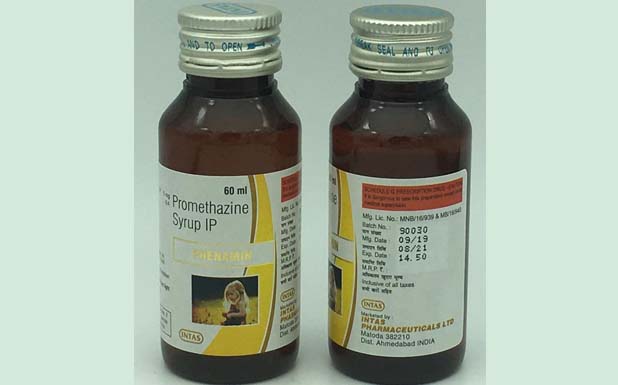
Indications: ● Allergic urticaria ● Anaphylaxis ● Conjunctivitis, Seasonal Allergic ● Coughing ● Dermographism ● Motion Sickness ● Nasal Congestion ● Postoperative pain ● Seasonal Allergic Rhinitis (SAR) ● Vasomotor Rhinitis ● Acute Allergic Reactions ● Perioperative nausea and vomiting ● Upper respiratory symptoms
Pharmacokinetics:
Oral promethazine is only 25% bioavailable due to first pass metabolism. Oral promethazine reaches a Cmax of 2.4-18.0ng/mL with a Tmax of 1.5-3h. The volume of distribution of promethazine is approximately 970L or 30L/kg. Promethazine is 93% protein bound in serum, mostly to albumin. Promethazine is predominantly metabolized to promethazine sulfoxide, and minorly to desmethyl promethazine and a hydroxy metabolite. Hydroxylation p]['romethazine is predominantly mediated by CYP2D6. It is mainly excreted in urine and the half-life of promethazine is approximately 12-15h.
Mechanism of Action:
Promethazine is an antagonist of histamine H1, postsynaptic mesolimbic dopamine, alpha adrenergic, muscarinic, and NMDA receptors. The antihistamine action is used to treat allergic reactions. Antagonism of muscarinic and NMDA receptors contribute to its use as a sleep aid, as well as for anxiety and tension. Antagonism of histamine H1, muscarinic, and dopamine receptors in the medullary vomiting center make promethazine useful in the treatment of nausea and vomiting.
Side Effects:
The product is possible safe for most adults. There is no disadvantage associated with the product if taken under the recommended usage however c-d muscle spasms.
Interactions: ● The metabolism of warfarin can be decreased when combined with Promethazine ● The risk or severity of adverse effects can be increased when Promethazine is combined with 5-methoxy-N,N-dimethyltryptamine, 4-hydroxycoumarin and 4-Methoxyamphetamine
Contraindications: ● Avoid alcohol consumption ● Do not take antacid along with the supplements ● Renal or hepatic impairment
Precautions: ● Do not exceed the recommended dose Keep out of reach of children ● The combination should only be used in pregnancy and lactation if benefits outweigh the risks