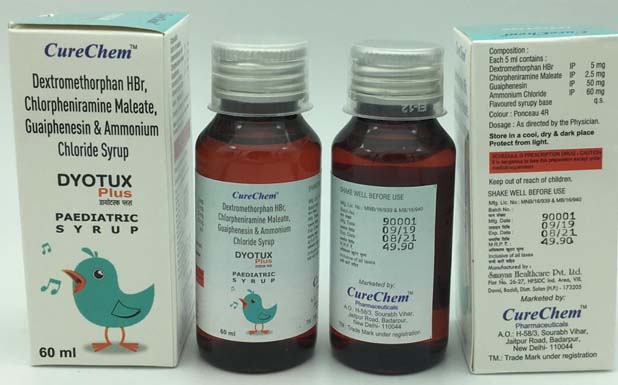
Indications:
● Coughs and upper respiratory tract symptoms
● Nasal congestion
● Allergy or common cold
Mechanism:
Ammonium Chloride:
is an inorganic compound. It works as Systemic acidifier. In liver ammonium chloride is converted into urea with the liberation of hydrogen ions (which lowers the pH) and chloride. Ammonium chloride can be used as an expectorant due to its irritative action on the bronchial mucosa. This effect causes the production of respiratory tract fluid which in order facilitates the effective cough.
It is completely absorbed from GIT within 3-6 hours. It is metabolised in liver to form urea and the metabolites are excreted in urine.
Chlorphenamine maleate:
is a H1 receptor antagonist used in allergic reactions, hay fever, rhinitis, urticaria, and asthma. This blocks the action of endogenous histamine, which subsequently leads to temporary relief of the negative symptoms brought on by histamine.
It is well orally absorbed with a plasma protein binding of 72%. It is metabolised in liver with a half-life of 21-27 hours.
Dextromethorphan:
suppresses medullary cough center and is an NMDA receptor antagonist (receptors, N-methyl-D-aspartate). It acts as a non-competitive channel blocker and is one of the widely used antitussives. It is also used to study the involvement of glutamate receptors in neurotoxicity. Dextromethorphan is categorized as an opioid drug that acts as antagonist to the NMDA glutamatergic receptor, it is an agonist to the opioid sigma 1 and sigma 2 receptors. It is also an alpha3/beta4 nicotinic receptor antagonist and targets the serotonin reuptake pump.
It is rapidly absorbed from GIT and is extensively metabolised to dextrorphan (active metabolite) in liver. The half-life is 3-6 hours.
Guaiphenesin:
is categorized as an expectorant that acts by enhancing the output of phlegm (sputum) and bronchial secretions via decreasing the adhesiveness and surface tension of such material. It may also act as an irritant to gastric vagal receptors, and recruit efferent parasympathetic reflexes that can elicit glandular exocytosis that is comprised of a less viscous mucus mixture. It is well orally absorbed and volume of distribution is 116L. It is metabolised in liver and is excreted in urine. The half-life is approximately 1 hour.
Side Effects:
● Blurred vision
● Dry mouth
● Nausea
● Stomach pain
● Constipation
● Skin rash or itching
Interactions:
● Chlorpheniramine can interact with tranylcypromine, isocarboxazid, sodium oxybate and ivacaftor
● Dextromethorphan can interact with isocarboxazid, phenelzine, rasagiline, selegiline and tranylcypromine
● Guaiphenesin may interact with duloxetine, phenylephrine and albuterol
● Ammonium chloride can interact with diuretics, Zoledronic acid and Empaglilozin
Contraindications:
● Severe hypertension
● Ventricular tachycardia
● Severe coronary artery disease
● Chronic bronchitis