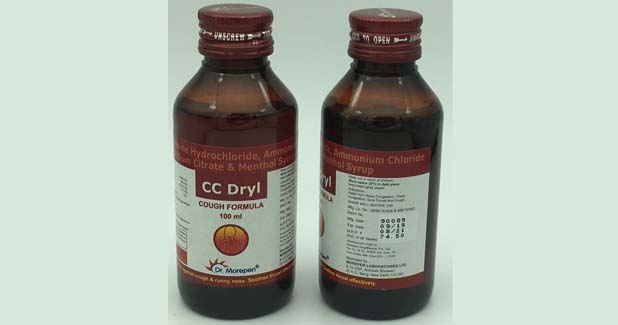
Indications:
● Relief of runny nose, watery eyes, itchy nose and sneezing due to common cold and allergy
● Cough
● Acute or chronic bronchitis
● Pneumonia
● Chronic obstructive pulmonary disease
● Patients with metabolic alkalosis
●Patients with hypochloremic states
● Cramping
● Gastric problems
Mechanism:
Ammonium Chloride:
is an inorganic compound. It works as Systemic acidifier. In liver ammonium chloride is converted into urea with the liberation of hydrogen ions (which lowers the pH) and chloride. Ammonium chloride can be used as an expectorant due to its irritative action on the bronchial mucosa. This effect causes the production of respiratory tract fluid which in order facilitates the effective cough.
It is completely absorbed from GIT within 3-6 hours. It is metabolised in liver to form urea and the metabolites are excreted in urine.
Diphenhydramine Hydrochloride:
acts on histamine H1 receptor as an inverse agonist. It structurally resembles the ethanolamine class of antihistaminergic agents. By antagonising the effects of histamine on the capillaries, it can reduce the tenseness of allergic symptoms. It also acts centrally as it crosses the blood–brain barrier and inversely agonizes the H1 receptors which can result in drowsiness.
Oral bioavailability of diphenhydramine is in the range of 40% to 60%, and peak plasma concentration occurs about 2 to 3 hours after administration. The primary route of metabolism is two successive demethylation of the tertiary amine. The elimination half-life of diphenhydramine has not been fully explored, but appears to range between 2.4 and 9.3 hours in healthy adults. The elimination half-life of diphenhydramine was 5.4 hours in children, 9.2 hours in young adults, and 13.5 hours in the elderly.
Sodium Citrate: is the sodium salt of citric acid. It is used as alkalinizing agent. It works by neutralizing excess acid in the blood and urine. It has been indicated for the treatment of metabolic acidosis. It also acts as a diuretic and increases the urinary excretion of calcium.
Time to reach maximum concentration in plasma is 98-130 min with 19-39L of volume of distribution. It is metabolised in liver and is excreted in bile. The half-life is 18-54 min.
Menthol: primarily activates the cold-sensitive TRPM8 receptors in the skin. Menthol, after topical application, causes a feeling of coolness due to stimulation of 'cold' receptors by inhibiting Ca++ currents of neuronal membranes. It may also yield analgesic properties via kappa-opioid receptor agonism.
Side Effects:
● Rash
● Fever
●Irregular breathing
● Bradycardia
● Progressive drowsiness
● Mental confusion
Interactions:
●Ammonium chloride can interact with diuretics, Zoledronic acid and Empaglilozin
● The metabolism of warfarin can be decreased when combined with Diphenhydramine
● The risk or severity of adverse effects can be increased when Diphenhydramine is combined with 7-Nitroindazole, 5-methoxy-N,N-dimethyltryptamine and 4-Methoxyamphetamine
● The risk or severity of bleeding can be increased when Sodium citrate is combined with warfarin and 4-hydroxycoumarin
Contraindications:
● Pregnant
● Breastfeeding
● Hypercapnia
●Ammonia toxicity