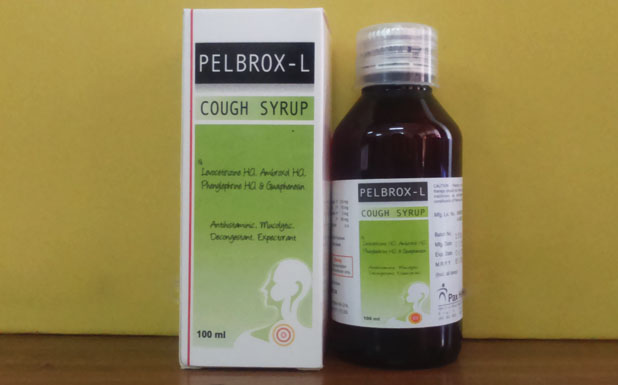
Indications: Cough associated with nasal congestion as in Respiratory Tract Infections/Allergies.
About Composition:
Ambroxol is the metabolite of Bromhexine and a mucolytic agent. Ambroxol acts to reduce the viscosity of tenacious mucous secretions by fragmenting long mucopolysaccharide chains. This results in liquefaction of viscid, mucoid respiratory secretions, which aids expectoration. Ambroxol stimulates the synthesis of phospholipids by alveolar cells and formation of surfactant lipids. It facilitates mucociliary clearance by intensifying the motion of the cilia present on the ciliated respiratory epithelium. Thus the airways are cleared and the patency of bronchioles and alveoli are re-established.
Studies indicate that Ambroxol also acts as an antioxidant. It inhibits the production of superoxide anion, hydrogen peroxide, hypochlorous acid (HOCl) and decreases the release of elastase and myeloperoxidase by activated neutrophils. Thus ambroxol protects lung tissue components against oxidative damage.
Ambroxol has a mild anti-inflammatory and cough suppressant action. It also enhances the concentration of chemotherapeutic agents in pulmonary tissues.
Levocetirizine is a third generation antihistamine that provides relief in allergic conditions. It is the active enantiomer of cetirizine. It reduces allergic vasodilatation and nasal mucosal congestion commonly seen in upper respiratory infections and allergies.
Guaiphenesin is an expectorant that increases respiratory tract fluid secretions and helps loosen phlegm and bronchial secretions. By reducing the viscosity of secretions, guaiphenesin increases the efficiency of the mucociliary mechanism in removing accumulated secretions from the upper and lower airway.
Phenylephrine is a sympathomimetic vasoconstrictor that has been used as a nasal decongestant. It constricts the blood vessels in the nasal mucous membranes and allows the air passages to open up. It is a relatively selective alpha-adrenoceptor agonist. The majority of the sympathomimetic action is due to direct stimulation of the adrenoceptors. At therapeutic doses, it does not cause significant stimulation of the central nervous system.
Pharmacodynamics:
Ambroxol belongs to a class of drugs called expectorants (aid expulsion of mucus as cough) or mucolytic (liquefy and loosen mucus). It works by liquefying and loosening thick mucus that can be coughed out easily. It helps in the production of a chemical called surfactant. Surfactant doesn't let the mucus to get stuck to the walls of airways and is easily coughed out.
Levocetirizine belongs to a group of medications called antihistamines. It acts by blocking a natural substance (histamine) that is produced in the body during an allergic reaction.
Guaiphenesin belongs to a class of agents called expectorants. It works by thinning the mucus in the air passages to make it easier to cough up the mucus and clear the airways.
Phenylephrine stimulates receptors on blood vessels and leads to constriction of blood vessels. This leads to decrease in the flow of blood in the blood vessels of nose, which in turn relieves nasal congestion.
Pharmacokinetics:
Ambroxol:
Absorption: Oral bioavailability is approx. 60% owing to the first pass effect. Plasma concentrations are in a linear relationship to the dose. Peak plasma levels are attained after 0.5 to 3 hours.
Distribution: Plasma protein binding is around 90% in the therapeutic range. Ambroxol is distributed swiftly and extensively from the blood into the tissues. The highest active ingredient concentrations are measured in the lung.
Metabolism: Studies in human liver microsomes showed that CYP3A4 is the predominant isoform for Ambroxol metabolism. Otherwise Ambroxol is metabolized in the liver mainly by conjugation.
Elimination: Around 30% of an oral; dose is eliminated via the first pass effect. The terminal half-life is about 10 hours. Total clearance is in the region of 600 ml/min, and renal clearance is 8% of total clearance.
Levocetirizine:
Absorption: Rapidly and extensively absorbed.
Distribution: Plasma protein binding about 90%.
Metabolism: Metabolism is less than 14% and by aromatic oxidation, N- and O-dealkylation, and taurine conjugation.
Elimination: The elimination is 85.4 % and 12.9% via urine and feces, respectively.
Guaiphenesin:
Absorption: Guaiphenesin is well absorbed from the gastro-intestinal tract following oral administration, although limited information regarding its pharmacokinetics is available.
Distribution: No information is available on the distribution of Guaiphenesin in humans.
Metabolism and Elimination: Guaiphenesin appears to undergo both oxidation and demethylation. Pharmacokinetics in Renal/Hepatic Impairment: There have been no specific studies of Guaiphenesin in subjects with renal or hepatic impairment. Caution is therefore recommended when administering this product to subjects with severe renal or hepatic impairment.
Phenylephrine:
Absorption: It is absorbed quickly and completely.
Distribution: The biological half-life is 2-3 hours.
Metabolism: The therapeutic plasma concentration of Phenylephrine is 0.04-0.1 mcg/ml.
Elimination: It is mainly excreted via the kidneys.
Common Side Effects:
Common side effects include:
Levocetirizine: Headache, fatigue, skin rash Phenylephrine: Headaches, vomiting, diarrhea, insomnia, restlessness and palpitations. However, there have been few reports of these with normal doses of Phenylephrine
Ambroxol: Abdominal discomfort, hypersensivity reactions
Guaiphenesin: Gastrointestinal discomfort, nausea, vomiting
Precautions:
● In moderate to severe renal insufficiency- dose adjustment may be needed.
● Hepatic insufficiency: The clearance of Levocetirizine may be reduced in cirrhotic patients, and hence lower doses are recommended.
● Elderly patients- dosage should be adjusted based on renal function.
● Concurrent administration of CNS depressants may have additive effect leading to sedation/somnolence.
● Patients with existing urinary retention, bladder-neck obstruction, or prostatic hypertrophy have the potential for exacerbation of their symptoms.
● Angle-closure glaucoma- potential for increased intraocular pressure/precipitation of acute attack.
● Patients intending to drive or engage in potentially hazardous activities or operate machinery are advised not to exceed the recommended dose and to avoid concurrent alcohol.
● Before taking this combination, tell your doctor if you are pregnant, plan to become pregnant, or are breast-feeding.
Contraindications:
This combination is not recommended for:
● Children ˂6 years of age
● Patients with end-stage renal failure [creatinine clearance ˂10 ml/min]
● Hypersensitivity to Levocetirizine, Phenylephrine, Ambroxol, Guaiphenesin or any ingredient in this preparation
Storage:
Store in cool and dry place.
Protect from direct sunlight.